
Call us now :08045811849
 Send Inquiry
 Send Inquiry
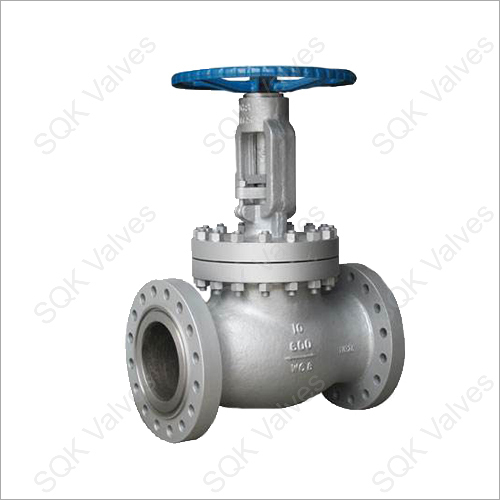
Gear Box Operated Globe Valve
MOQ : 5 Units
Gear Box Operated Globe Valve Specification
- Sealing
- Metal to Metal / PTFE
- Connection
- Flanged
- Material
- Cast Steel / WCB / CI
- Power
- Manual (with Gear Box)
- Pressure
- Class 150/300/600
- Media
- Water, Oil, Gas, Steam
- Working Temperature
- Up to 425C
- Port Size
- 2 inch to 24 inch
- Surface
- Painted / Coated
- Shape
- Round Body
- Application
- Industrial, Oil & Gas, Petrochemical, Power Plant
- Color
- Blue / Grey
- Bonnet Type
- Bolted Bonnet
- End Connection
- Raised Face (RF), Flat Face (FF)
- Operation
- Handwheel with Gear Box
- Flow Characteristic
- Linear
- Body Coating
- Epoxy Painted
- Design Standard
- BS 1873 / API 600
- Leakage Class
- Class VI as per API 598
- Stem Material
- Stainless Steel
- Face to Face Dimension
- ASME B16.10
- Test Standard
- API 598
- Packing
- Graphite / PTFE
- Mounting
- Horizontal / Vertical
Gear Box Operated Globe Valve Trade Information
- Minimum Order Quantity
- 5 Units
- Supply Ability
- 200 Units Per Month
- Delivery Time
- 7 Days
About Gear Box Operated Globe Valve
Gear Box Operated Globe Valve provided by our company is tested against multiple quality parameters to ensure its high quality. The valve is durable, corrosion resistant, smooth, and easy to install. It is possible to operate the globe valve manually as well as motorized. Engineers at our company make Gear Box Operated Globe Valve using the latest technology. With this valve, ease of operation is combined with higher efficiency.
We are known for our high quality, integrity, long life, robust BS 1873 Globe Valves.
Their design ensures a tight seal and ease of operation. Valves are available with flanged or buttweld ends in pressure ratings ranging from 150 to 2500, and come in various materials of construction.
Main features of Gear Box Operated Globe Valve
- Valves with pressure seal bonnets, welded body-bonnets, and sealed joints
- Available are globe valves with a seal on the bellows
- Joints between the body and bonnet contain spiral-wound stainless steel gaskets with graphite fillers to protect against leaks
- An ACME threaded stem ensures smooth operation
- Tapered shoulder of the stem ensures back seating
- The gland assembly has self-aligning studs and nuts for tightening
- Globe and check valve seats with hard-faced bodies
- The spring-loaded disc on these check valves is suitable for any horizontal application
- Electrical actuators can be offered on gate valves and globe valves
- Stainless steel forging for body and bonnet of Cryogenic valves, ensures minimum heat loss, impact strength and resistance to corrosion
- MR-0175 and other special NACE requirements are supported with valves
T & Y types Globe Valves with Pressure Seal Bonnets conforming to ASME B16.34
For applications involving high pressure, ASME B16.34 Y Type and T Type globe valves feature pressure seal bonnet designs. These valves are used extensively in high temperature and high pressure steam applications, as well as in oil, gas, chemical, and water applications in fertiliser plants, thermal power plants, and petrochemical plants and refineries. There are types with buttweld ends with pressure ratings up to 2500 in carbon steel and alloy steel materials.
Cast Steel Cryogenic Globe Valves
The best solution for these low-temperature and cryogenic applications is a specially adopted globe valve with an extended bonnet. Low temperature and cryogenic globe valves and check valves for processing, storing, and transporting liquefied gases, such as ethanol, LPG, LNG, hydrogen, helium, oxygen, nitrogen, and argon, are available from us. Carbon steels designed for low temperature service such as LCC and LCB can handle temperature levels as low as -460 C. ASME Class 150 to 1500 cryogenic globe valves are available. The extended bonnets are available according to BS 6364 and / or customer specifications.
Versatile Flow Control and Robust Design
This globe valves gear box operation enables efficient modulation and reliable shutoff in critical process lines. Its linear flow characteristic ensures precise control for a variety of media, including water, oil, gas, and steam. The round body is epoxy coated to withstand corrosive environments, while its bolted bonnet and sturdy stem offer durability and extended service life. The valve suits both horizontal and vertical mountings, supporting seamless installation in diverse setups.
Stringent Standards and Quality Assurance
Manufactured to BS 1873 and API 600, with pressure testing as per API 598 and face-to-face dimensions aligning with ASME B16.10, this valve ensures safety and robust quality. The Class VI leakage rating, along with flexible packing (graphite/PTFE) and metal or PTFE sealing, provides dependable isolation, minimal leakage, and lasting performance in demanding industrial applications. Every valve is factory coated, painted, and quality-checked before distribution.
FAQs of Gear Box Operated Globe Valve:
Q: How does the gear box operation enhance the performance of this globe valve?
A: The gear box reduces manual effort required to operate the valve while enabling smooth, precise adjustment of flow. This mechanism is suitable for larger port sizes or applications needing fine flow modulation in industrial setups.Q: What is the recommended process for installing this valve in an industrial pipeline?
A: Installation is straightforward, as the valve accommodates both horizontal and vertical orientations. Ensure the flanged ends are properly aligned and tightened, the bolted bonnet is securely fastened, and all safety protocols from ASME B16.10 are followed for optimal performance.Q: When should this globe valve be used over other valve types?
A: Use this valve when precise flow regulation, shutoff, and tight sealing are required, especially in medium- to high-pressure environments. Its linear flow characteristic and Class VI leakage rating make it ideal for controlling water, oil, gas, or steam in power plants, petrochemical, or oil & gas facilities.Q: Where can this valve be installed in terms of mounting positions and industrial environments?
A: The valve is designed for installation in both horizontal and vertical pipelines. Its epoxy-coated body and robust construction make it suitable for varied environments such as industrial plants, refineries, and oil & gas facilities.Q: What maintenance is required to ensure the valves longevity?
A: Regular inspection of the bonnet bolts, stem packing (graphite/PTFE), and seat sealing is recommended. Periodic cleaning and reapplication of the protective coating can prevent corrosion and ensure smooth operation over the valves service life.Q: What are the key benefits of the epoxy painted body and metal/PTFE sealing?
A: The epoxy coating protects the valves body from corrosion and harsh chemicals, extending lifespan, while the metal-to-metal or PTFE sealing offers superior leakage resistance and operational reliability in high-pressure or high-temperature applications.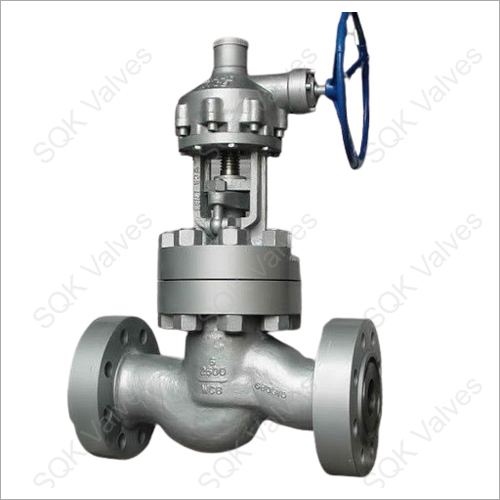
Tell us about your requirement

Price:
Quantity
Select Unit
- 50
- 100
- 200
- 250
- 500
- 1000+
Additional detail
Mobile number
Email

More Products in Globe Valve By Construction Category
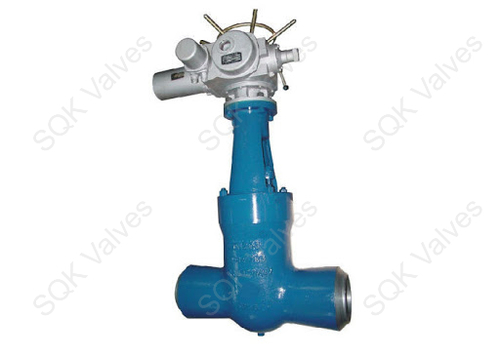
SQK Electric Motor Globe Valve
Price Range 5000.00 - 30000.00 INR / Unit
Minimum Order Quantity : 5 Units
Color : Blue and Silver
Pressure : Other, PN16, PN25, PN40
Material : Other , Cast Iron / WCB / CF8 / CF8M
Surface : Other , Smooth Painted Finish
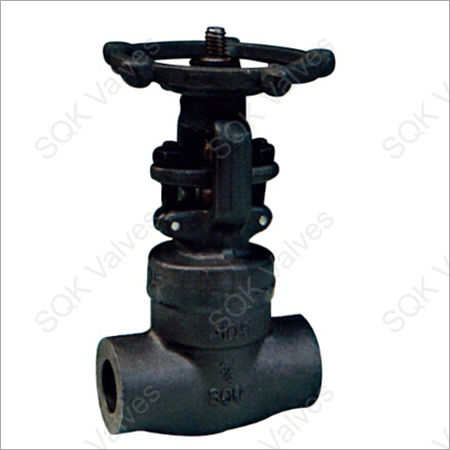
Welded Bonnet Globe Valve
Price Range 5000.00 - 30000.00 INR / Unit
Minimum Order Quantity : 5 Units, ,
Color : Silver/Grey
Pressure : Other, Class 150 to Class 2500
Material : Other , Carbon Steel, Stainless Steel
Surface : Other , Polished
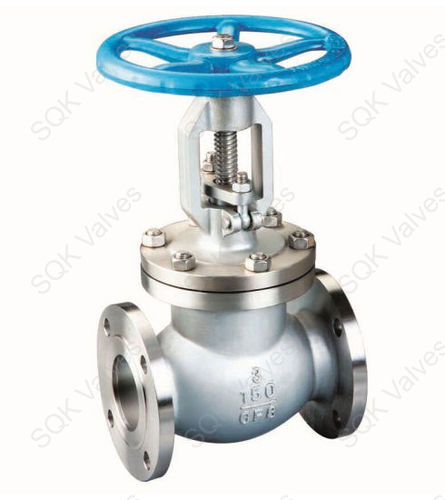
SQK Flexible Wedge Globe Valve
Price Range 5000.00 - 30000.00 INR / Unit
Minimum Order Quantity : 5 Units
Color : Grey
Pressure : Other, PN16, PN25, PN40
Material : Other , WCB / Cast Iron / Stainless Steel
Surface : Other , Painted / Coated
Bolted Bonnet Globe Valve
Price Range 5000.00 - 30000.00 INR / Unit
Minimum Order Quantity : 5 Units
Color : Silver (Metallic Grey)
Pressure : Other, Class 150 to 600 (PN16 to PN100)
Material : Other , Carbon Steel / Stainless Steel / Alloy Steel
Surface : Other , Shot Blasted / Painted

 Send Inquiry
Our Products
- Globe Valve
- Globe Valve By Construction
- Globe Valve By End Connection
- Globe Valves By Design
- Globe Valves By Materials
- Globe Valves
- Plug Valves
- Plug Valves By Construction
- Plug Valves By End Connection
- Plug Valve By Design
- Plug Valves By Materials
- Plug Valve By Class
- Ball Valve
- Ball Valves
- Ball Valves By End Connection
- Ball Valves
- Ball Valves By Material
- Ball Valve By Class - Pressure Rating
- Gate Valve
- Gate Valves By Construction
- Gate Valves By End Connection
- Gate Valves By Design
- Gate Valves By Materials
- Gate Valves By Class
- Piston Valve
- Check Valve
- Swing Check Valves By Construction
- Swing Check Valves By End Connection
- Swing Check Valves By Design
- Swing Check Valves By Materials
- Swing Check Valves By Class
- Piston Valves By Construction
- Piston Valves By End Connection
- Piston Valve By Design
- Piston Valves By Materials
- Piston Valve By Class


Plot No. 46 & 49, Survey No. 62/1, Behind New Ekta Weighing Bridge, Panvel Road, Dahisar Mori, near Taloja MIDC,Navi Mumbai - 400612, Maharashtra, India

Mr Saquib Khan
(Director )
Mobile :08045811849
 Send Inquiry
 Send SMS
Developed and Managed by Infocom Network Private Limited.
 English
 Spanish
 French
 German
 Italian
 Chinese (Simplified)
 Japanese
 Korean
 Arabic
 Portuguese